Table of Contents
ToggleA tiny kitchen doesn’t mean tiny cooking ambitions, or tiny functionality. The right layout turns cramped square footage into an efficient, livable workspace. Whether you’re renovating a 1970s cottage, a modern apartment, or a full-blown tiny home, your kitchen layout determines everything: workflow, storage capacity, and whether you’ll actually enjoy cooking in the space. This guide covers seven proven tiny kitchen layouts that work in real homes, plus the reasoning behind each design so you can choose the best fit for your footprint.
Key Takeaways
- The right tiny kitchen layout maximizes workflow and storage by organizing appliances and counters strategically—galley, single-wall, L-shaped, and open-concept designs each offer distinct advantages for different spaces.
- Galley kitchens minimize wasted steps by keeping the sink, stove, and refrigerator tight and efficient along two parallel walls, but require clear demarcation to prevent traffic interruption.
- Single-wall kitchens demand relentless vertical storage and workarounds like pull-out cutting boards and fold-down surfaces, with pale countertops and open shelving making the space feel less cramped.
- L-shaped kitchen layouts maximize corner real estate and counter space, with lazy Susans and blind corner cabinets recovering otherwise hard-to-access storage.
- Open-concept tiny kitchens require intentional design discipline since every clutter pile becomes visible—invest in closed storage and reserve open shelving for styled items only.
- Smart storage solutions like appliance garages, drawer dividers, pull-out systems, and under-sink organizers can recover up to 40% of wasted cabinet depth in tiny kitchens.
The Galley Kitchen: Efficiency Meets Compact Design
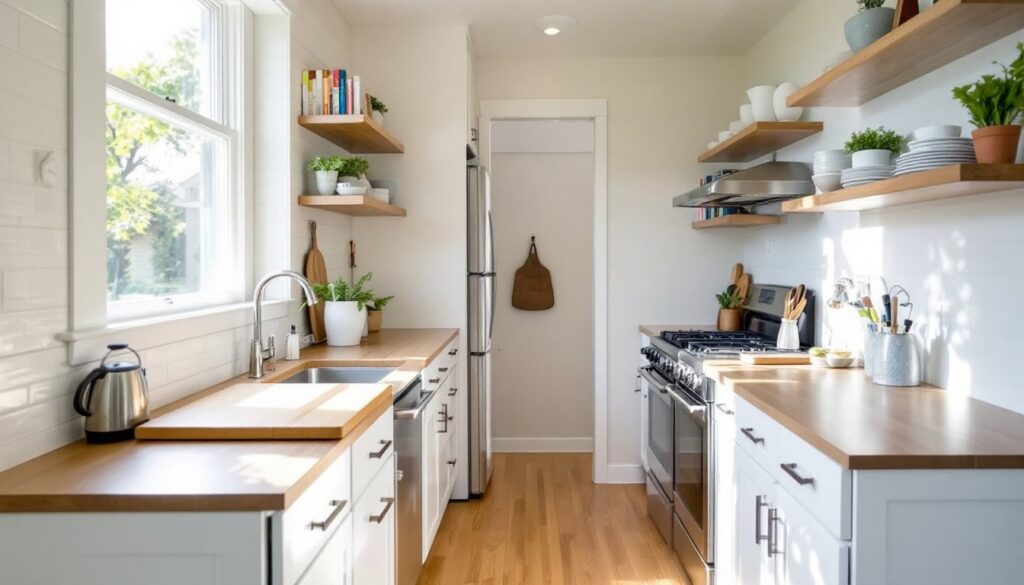
The galley kitchen, counters and appliances on two parallel walls, is the workhorse of tiny spaces. Restaurant kitchens use this layout for a reason: it minimizes wasted steps and keeps the cook’s triangle (sink, stove, refrigerator) tight and efficient.
A galley typically runs 8–12 feet long and 6–8 feet wide, though some squeeze into tighter footprints. The two-wall configuration means you’re never more than a step away from your next station. One wall typically houses the cooking appliances (range, oven) and the other holds the sink and refrigerator, with counter space divided strategically between them.
The main drawback? Traffic flow. If your galley is a pass-through to another room, people constantly interrupt your work. Install a clear demarcation, even a change in flooring material or a subtle step, to signal that this is an active kitchen, not a thoroughfare. Overhead cabinets on both sides maximize vertical storage, which is critical in tight quarters. Wall-mounted open shelving can feel less cramped than floor-to-ceiling closed cabinets if you keep items organized and styled intentionally.
One smart move: position your refrigerator at one end of the galley rather than in the middle. This keeps the cold appliance from blocking sightlines and improves traffic flow if the galley opens into an adjacent room.
Budget $15,000–$30,000 for a galley renovation (cabinets, countertops, appliances, basic electrical), though this varies widely by region and material choice.
Single-Wall Kitchens for Ultra-Tight Spaces
When you’ve got only one wall to work with, think studio apartments, lofts, or the end of a single room, a single-wall kitchen is your only option. Everything lines up: refrigerator, sink, stove, storage, and counter space along one side.
Single-wall kitchens range from 8 to 16 feet long and about 2–3 feet deep. They demand relentless organization and vertical storage thinking. There’s virtually no counter workspace once your appliances are installed, so pull-out cutting boards, fold-down work surfaces, and cart-mounted prep stations become essential tools, not luxuries.
The critical challenge is appliance sequence. Order them left to right in logical workflow: refrigerator (source), prep counter (if you can fit one), sink (cleanup), stove (cooking), then more counter or cabinet. Many single-wall kitchens benefit from an offset or angled counter extension, a small island or peninsula that juts out perpendicular to the wall. Even 18–24 inches of depth on a 3-foot extension gives you crucial prep space and a visual break from the linear layout.
Light is your friend here. Apartment Therapy highlights that pale countertops, open shelving, and bright finishes make single-wall kitchens feel less tunnel-like. Consider open shelving for frequently used items (glasses, plates, spices) to reduce visual clutter and create depth.
The L-Shaped Layout: Maximizing Corner Real Estate
L-shaped kitchens use two walls that meet at a corner, offering more counter space and workspace than galley or single-wall designs. They’re common in small apartments and homes because they create a natural working zone without blocking traffic flow through adjacent rooms.
A basic L-shaped kitchen might measure 10 feet on one wall and 8 feet on the adjacent wall, creating roughly 80 square feet. The corner itself is prime real estate, and the trickiest to use efficiently. Standard corner cabinets waste space because the interior is hard to access. Blind corner cabinets (single-hinged doors opening to a deep compartment) or lazy Susans (rotating shelves) recover that lost space. Some households opt for open corner shelving to avoid the inaccessibility problem entirely.
The sink often anchors the corner or sits on one leg of the L, the refrigerator on the other leg, and the stove positioned to complete the triangle. This arrangement keeps the cook’s movement efficient and lets you face the room while cooking, which is why many people prefer L-shaped over galley layouts.
Watch for overhead cabinet alignment at the corner junction, they can feel heavy and oppressive if not thoughtfully spaced. Stagger them or break them up with open shelving or a window to lighten the corner visually. Many tiny kitchens benefit from using Tiny Home Design Software to test corner placements and appliance positions before committing to cabinet orders.
Open Concept: Blending Your Kitchen With Adjacent Rooms
Open-concept tiny kitchens dissolve the boundary between cooking and living spaces. Instead of a closed room with a door, your kitchen flows visually and spatially into a dining or living area. This maximizes perceived space and lets you cook while entertaining, but it requires discipline and intentional design.
When walls come down, your kitchen becomes the visual anchor of the whole area. Every unwashed dish, open cabinet, and clutter pile becomes part of the living room décor. Countertops need to be consistently clear, appliances should match or complement your living room aesthetic, and storage must be truly hidden or beautifully organized.
The trade-off: opening up walls is often structural work. Load-bearing walls require a beam header (typically steel or laminated veneer lumber, or LVL) to carry the weight of the structure above. This is not a DIY demolition project, hire a structural engineer to evaluate the wall and a licensed contractor to install the header. Expect $3,000–$8,000 just for the structural work, plus finishing, electrical rerouting, and HVAC adjustments.
Some jurisdictions require permits for any load-bearing wall removal: others allow the work only under licensed contractor oversight. Check your local building department before you commit to an open-concept renovation.
Creating Visual Flow and Preventing Clutter Overflow
Define your kitchen zone without walls. A change in flooring material (wood to tile, for example) signals the boundary. A peninsula counter or partial-height wall also creates definition while maintaining openness. Kitchen experts at The Kitchn note that strategic zoning helps open kitchens feel intentional rather than haphazard.
Install plenty of closed storage (cabinetry, pantries) to hide the working mess. Open shelving should display only styled, intentional items: attractive serveware, cookbooks with nice spines, potted herbs. Deep drawers and pull-out storage systems keep small appliances and utensils out of sight, maintaining the clean sightlines an open kitchen needs to feel spacious.
Smart Storage Solutions for Tiny Kitchens
Storage is the heartbeat of a functional tiny kitchen. Every inch must count, and your storage strategy determines whether the space feels organized or crammed.
Vertical storage comes first. Floor-to-ceiling cabinets, wall-mounted shelves, and pegboards capture otherwise wasted wall space. Open shelving works in some layouts: closed cabinets in others. The key is keeping what’s visible (open shelves) absolutely intentional and styled.
Drawer dividers and pull-out systems multiply usable space inside standard cabinets. A 24-inch base cabinet with no organization wastes 40% of its depth. Sliding shelves, tiered spice racks, and pull-out pantry units make every corner accessible. Soft-close hinges cost a bit more but prevent the slamming that makes tiny kitchens feel chaotic.
Appliance garages (a cabinet with a roll-up or swing-up door) hide countertop clutter, your coffee maker, toaster, and blender live inside, ready but out of sight. A 15-inch-wide, 12-inch-tall unit costs $50–$150 and saves enormous visual peace.
Magnetic strips and wall-mounted magnetic spice jars free up cabinet space for bigger items. A few pots and pans hang from hooks: the rest nest efficiently inside cabinets. Remodelista’s curated collection showcases storage-smart products designed specifically for compact layouts.
Under-sink organization often gets overlooked. A pull-out caddy, tiered shelf riser, or sliding drawers transforms that wasted zone into accessible storage for cleaning supplies, trash, and recycling. Many tiny kitchens now incorporate a Tiny Home Schoolroom style approach, using the kitchen table for meal prep and assignments, which means keeping counters clear becomes non-negotiable.
Measure twice: appliance heights, cabinet interior dimensions, and the actual depth of your countertops. Off-the-shelf organizers don’t always fit standard cabinet interiors (nominal 24 inches is usually closer to 22.5 inches actual width). Wasted organizers are money down the drain.
Conclusion
Your tiny kitchen layout isn’t a compromise, it’s a choice. Whether you’re building a galley, maximizing an L-shaped corner, or opening up to an adjacent room, the right layout matches your cooking style, traffic flow, and storage needs. Invest in planning before you order cabinets or swing a sledge. A well-designed tiny kitchen works harder and feels larger than a poorly planned spacious one.